
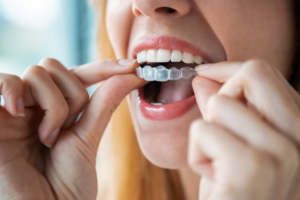
It’s difficult to control your habits when you’re stressed, and unfortunately, grinding and clenching your teeth puts a lot of pressure on your pearly whites. Bruxism (a fancy word for “teeth grinding and clenching”) can cause premature enamel wear, and in severe cases even lead to breakage. So if you’re considering an Invisalign treatment, you’re probably wondering whether the plastic trays can handle all that!
Rest assured, teeth grinding and clenching doesn’t affect Invisalign as negatively as you might think. Keep reading for the details.
How Does Invisalign Work?
Invisalign aligners gently shift teeth into straighter positions by applying increasingly greater degrees of pressure. Advancements to the design have been made over time, enabling the unique trays to correct more complex misalignments. But one thing that has always stayed the same is the crystal clear profile that makes Invisalign aligners, well, almost invisible!
After taking precise impressions of your teeth, your Invisalign dentist will use the measurements and their knowledge of oral anatomy to customize your trays. They’ll be entirely unique to your smile, and perfectly suited to your orthodontic needs.
Bruxism During Invisalign Treatment
Whether you primarily grind your teeth during the day or at night, a set of Invisalign aligners could actually help protect your pearly whites from harm. The comfortable, customized shape of the trays can effectively soften the pressure exerted on your teeth. That said, in order for Invisalign treatment to be successful, you have to wear the aligners for at least 22 hours every day. If you wear a special nightguard for bruxism, Invisalign might not be ideal, since you would have to remove the aligners to wear your nightguard.
Before you write Invisalign off completely, though, be sure to talk to your dentist. It’s possible you could still undergo Invisalign with a slightly longer treatment timeline, or that the aligners could shield your teeth in place of your nightguard temporarily. Your dentist can help you determine the best option for your smile!
About the Author
Dr. Zahara Munis attentively listens to each patient’s needs, and carefully personalizes their treatments so they can achieve the best results possible. If you’re worried about how bruxism will impact your Invisalign aligners, she’ll examine your mouth closely and help make sure you’re set up for success. To schedule a consultation and learn more about your options, contact Dr. Munis’ office at 512-371-7239.